
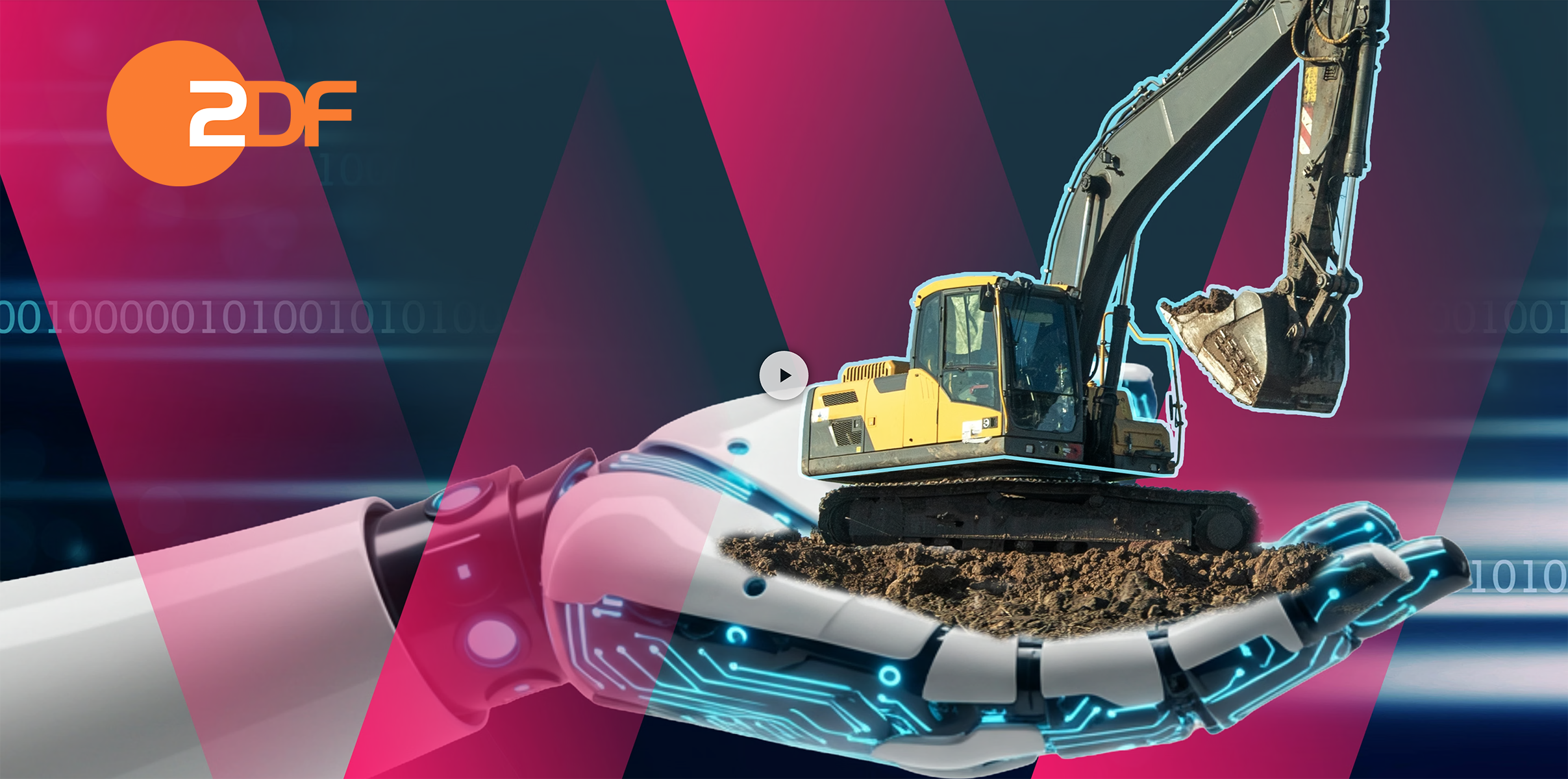
Germany has a building problem, and everyone can feel it. Flats are scarce, schools are overcrowded, kindergarten places run out before the applications are even processed, and the backlog of buildings waiting to be renovated keeps growing. The usual explanation is that construction is slow, expensive and short on people. All true. The more interesting question is the one a new ZDF WISO documentary decided to ask: not whether artificial intelligence could eventually help fix this, but which companies are already using it on real building sites today.
The answer, it turns out, is more than most people expect. And PT1 had a front-row seat.
Why this documentary matters
For years, "AI in construction" was a conference topic. A slide in a pitch deck. A possible future that always seemed to sit a few years out. That framing is now out of date, and the ZDF WISO team, led by Monique Marmodée, set out to show why. Rather than speculate, the film went to actual sites and actual companies to document where the technology has quietly moved from concept into daily practice.
To place those individual innovations in the context of the whole industry, the documentary brought in two expert hosts. One of them was Anja Rath, Managing Partner at PT1 Ventures. The other was PT1 portfolio founder Emanuel Heisenberg, founder of ecoworks and one of the sharpest minds in serial renovation, the practice of retrofitting existing buildings with pre-made, standardised components so the work goes faster and cheaper. Their role was to answer the questions a viewer actually has. What is genuinely status quo today? Where does the real leverage sit? And what could finally get German construction moving again?
That is a specific kind of expertise, and it is the reason a public broadcaster asked PT1 Ventures to help narrate the state of an entire sector. Investing in the physical world means understanding it at the level of drones, robots and concrete, not just spreadsheets. This documentary is a good marker of where that understanding now sits.
From "possible scenario" to working practice
The most striking thing about the film is how ordinary the technology has become on the ground.
Take building surveys. The Berlin company Lumoview sends a handheld scanner through a building, and AI assembles the captured data into a usable digital model in seconds rather than the days a manual survey would take. For anyone trying to plan a renovation, that collapses one of the slowest and most error-prone steps in the whole process.
Or take a large, established contractor. GOLDBECK, one of Germany's construction heavyweights, has made AI part of its forward strategy and already runs it in production at specific points in its operations. This is not a startup experimenting at the edges. It is an industry leader treating AI as core infrastructure.
Around those two anchor cases sits a wider set of applications that the film makes concrete: drones aggregating site data in real time, robots monitoring and documenting construction as it happens, and planning phases compressed by AI so the renovation backlog finally starts to shift. Each one attacks a specific bottleneck. Together they change the economics of building.
It is the same shift PT1 backs directly. Our portfolio company AUAR (Automated Architecture) pre-fabricates building modules with robots in small, local micro factories, bringing the precision and speed of manufacturing to construction without shipping components halfway across a continent. Seen next to Lumoview's instant surveys and GOLDBECK's production deployments, AUAR's robots are not a curiosity. They are one node in a sector that is genuinely re-tooling itself.
These are no longer possible scenarios. They are practice.
Why this is the PT1 thesis in real life
PT1 Ventures invests to upgrade the physical world, across three pillars: Electrify, Automate and Fortify. Construction sits squarely in the last of those, and this documentary is a compact case study of the thesis working out in reality.
The physical world does not get upgraded by software alone. It gets upgraded when software, robotics and hard-won building expertise meet on an actual site, under real constraints, solving a problem someone was previously solving by hand. That is exactly what the film captures, and it is exactly the intersection PT1 spends its time in: founders who can operate a robot and a construction schedule with equal fluency.
Being asked to help explain that story to a national audience is not the point in itself. The point is what it reflects. The companies solving Germany's building crisis are already here, already deployed, and already worth taking seriously. PT1's job is to find them early, back them, and help the rest of the industry catch up.
Watch it
The documentary aired on ZDF and is available for free in the ZDF Mediathek here.
If you are building at the intersection of AI, robotics and the physical world, this is the space we invest in.
We would like to hear from you.