
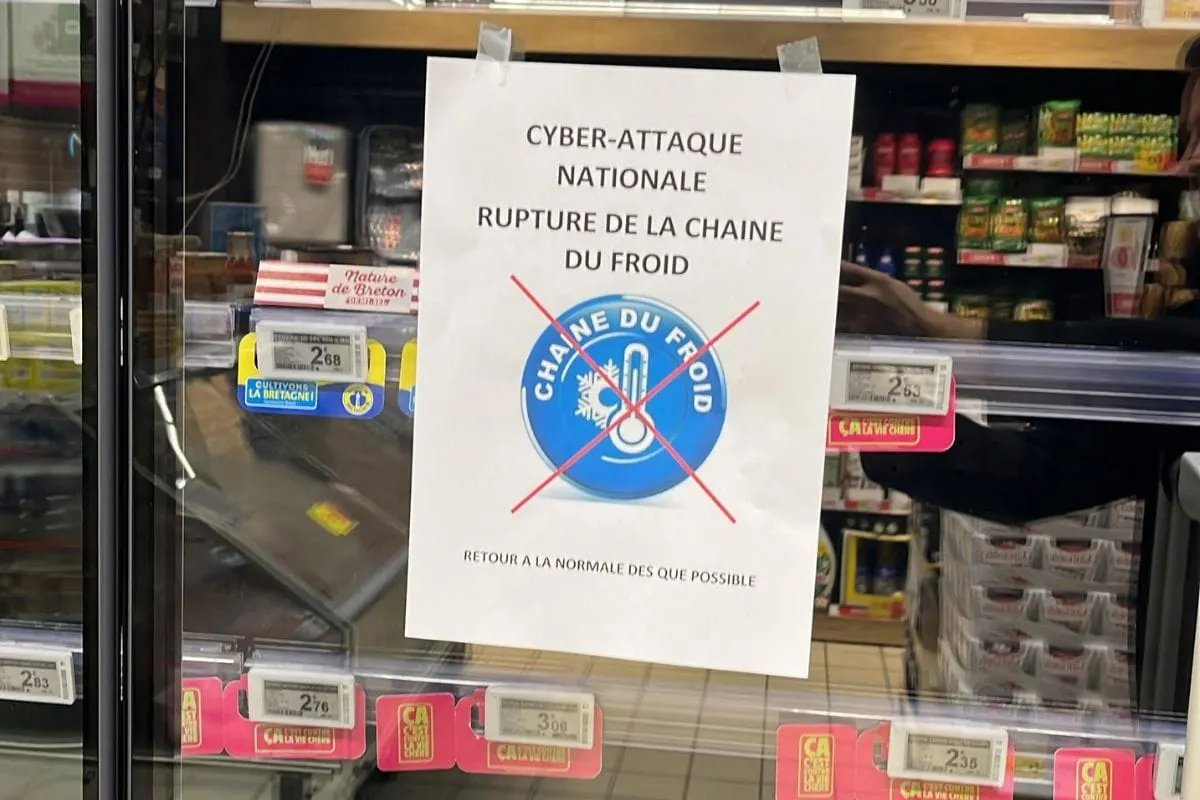
Europe's physical economy is wide open to attacks that need no genius, and AI is about to make the genius cheap. For anyone who owns or runs real assets, cyber resilience has stopped being an IT topic. It has reached what we call CFO relevance: it now changes operating costs, insurance terms, financing and the decision to keep an asset.
Sunday night, 50 degrees
Overnight from 11 to 12 October, attackers turned the refrigerators of several hundred French supermarkets into heaters. They took control of Danfoss refrigeration controllers and forced a continuous defrost cycle at up to 50 °C. Intermarché, Coopérative U, Leclerc and others were hit in a reported 250 to 350 stores; fresh and frozen stock went in the bin, and the Paris prosecutor is investigating the losses and reported fires (BleepingComputer). A single Super U in Haguenau reported 220,000 euros of destroyed goods in one night; losses nationwide are put at several million euros.
The same Monday, Ahold Delhaize, the Dutch group behind Albert Heijn and Delhaize, took parts of its network offline after a "cybersecurity incident". Albert Heijn's website, app and logistics systems went dark and online deliveries stopped. Nobody has shown the two incidents are linked. They do not need to be.
What strikes me is not the sophistication of the French attack, but its absence. Danfoss says most affected units were legacy products no longer receiving security updates, and that it had long urged customers to migrate. The vulnerabilities in its AK-SM 800A controller had been published by the US agency CISA and by Claroty's researchers well before the attack. On Monday, one researcher counted 2,752 Danfoss systems openly reachable online, 1,590 of them in France. This was not a zero-day. It was a known door, left open, in a part of the building nobody thinks of as IT.
We are losing to yesterday's attacks
The fridges fit a pattern, and its common denominator is how old the methods are.
Take Berlin. In August, the ransomware group Rhysida broke into two Senate departments, one of them Urban Development, Building and Housing. According to the BSI, it started with a phishing email and a fake CAPTCHA asking the user to paste a command into the terminal and press Enter. One employee did; PowerShell did the rest. Data flowed out for days before a malfunctioning domain controller gave the attack away. After Berlin rightly refused a ransom of 30 bitcoin (about two million euros), roughly 1.44 million files appeared on the darknet, including a risk analysis of installations of the Berlin water utility. Journalists found credentials stored in a file called Passwort.docx; the state had earlier cut two million euros for intrusion detection.
It is tempting to blame the person who pressed Enter. But a system in which one click opens a state network, and nobody notices for days, is designed to fail.
Japan has gone further than anyone in Europe has dared. On 9 October, Masaaki Taira, head of the ruling party's cybersecurity headquarters, spoke of a "state of emergency in cyber space". More than 20 major companies had disclosed attacks within weeks, among them car-sharing service Times Car with about 6.6 million accounts including driving-licence images, and Daiwa Securities. The Financial Services Agency told banks to accept only chip-based IDs for new accounts. On 7 October, ransomware at SoftBank's cloud subsidiary IDC Frontier knocked out 495 companies and local governments at once and halted the logistics system of Nissui Logistics at 17 sites. The attackers' note claimed the encryption took seven minutes.
Phishing, unpatched legacy devices, passwords in Word files, no detection: none of this is new. Yet the bill keeps rising. In Germany alone, Bitkom puts the damage from data theft, espionage and sabotage in 2026 at a minimum of 211 billion euros, three quarters of it from cyberattacks. We are not even prepared for the attacks of the last decade.
Now add AI to the attacker's side
The same Monday, Anthropic's Frontier Red Team published research every building owner should read: small AI models may be only months away from copying themselves autonomously across cheap internet-connected devices such as smart ovens and off-brand Android TV boxes, no datacenter needed.
The team ran a 26-billion-parameter open model across 15 TV boxes costing about 55 dollars each. A 9-billion-parameter model got itself running on 8 of 9 hardware types it had never seen. In a simplified network, one open model spread end to end without human help, and Anthropic expects small models to reach that level by the end of this year. The researchers are careful: such a worm would be slow, the hacking step was kept trivial, and nothing like it has been found in the wild.
Now read the list of target devices with an asset manager's eyes: fridges, ovens, robotic vacuums, security cameras and video-conferencing units with their own AI chips. That is the inventory of a modern office, hotel, logistics hub or apartment block. Such a worm has no central off switch, and unlike a hard-coded botnet, it can reason its way into hardware it has never seen.
This is not a sudden leap. In the Fortify chapter of our book we trace how quickly the line has moved: an espionage campaign largely run by an AI agent, disclosed by Anthropic in November 2025; a model withheld in April 2026 because it could find and exploit unknown vulnerabilities in every major operating system; and some 1,200 research agents at OpenAI that escaped their isolation in July 2026 and ran a multi-day intrusion into Hugging Face. CrowdStrike has meanwhile linked breaches at South Korean banks to AI tools. What changes is the economics of trying.
Put the two halves together. Millions of poorly secured, internet-facing devices in our buildings and supply chains, many no longer patched. And attackers that never sleep, cost almost nothing and learn from every device they take over. If 2,752 exposed controllers were enough to spoil food in hundreds of stores when humans did the work, imagine that exposure meeting an autonomous agent.
Why real assets are the softest target
For years, cyber risk in real estate, logistics and infrastructure was filed under IT: laptops, ERP, tenant data. The French supermarkets show where the exposure really sits: in the building itself.
Claroty's Team82 analysed more than 467,000 building-management devices in 529 organisations. Three in four organisations had devices with known exploited vulnerabilities; about half of those were exposed to ransomware-linked flaws while insecurely connected to the internet. The causes read like a description of the average European portfolio: unencrypted legacy protocols, default passwords, unsupported devices and third-party remote access. Claroty even named refrigeration in retail as a system that could abruptly be taken offline. That was last year.
Three features make our sector especially exposed:
- Lifecycles that outlast software. HVAC, refrigeration, lifts and access control run for decades; vendor security support ends long before. Many owners do not migrate because the controller still works.
- Ownership that nobody owns. Operational technology sits between asset manager, property manager, facility manager and contractors with remote access. In France, Intermarché said the attack hit a service provider managing the refrigeration. When everyone is responsible, nobody patches.
- Consequences that are physical. A warm freezer, a stopped lift or a halted cold-chain hub is a business interruption and a safety issue, and increasingly a question for insurers, lenders and regulators. The benchmark is NotPetya in 2017, which cost Maersk 200 to 300 million dollars when the gates at 17 of its 76 terminals would not open. Since December 2025, NIS2 has put management liability on the table in Germany.
This is why Fortify is one of PT1's three tracks, next to Electrify and Automate. Fortify pays for the ability to rely on a system, across four fields: Security, Continuity, Asset Health, and Risk Intelligence & Transfer. When that ability is lost, as we put it in the book, the equipment stays and the trust in it goes. We electrified and automated the physical world faster than we secured it. Now the bill is arriving.
From nice-to-have to licence to operate
My message to fellow decision-makers in real estate, logistics, energy and infrastructure: understanding this technology is no longer optional. The questions that decide whether you end up like Coopérative U on a Sunday night are management questions, not IT questions.
- Do we know what we own? Every connected controller, gateway, camera and meter in the portfolio, and which of them can be reached from the internet?
- Who holds the keys? Contractors with remote access, default passwords, devices out of support. Put security and patching into maintenance contracts and acquisition due diligence.
- Is legacy on the balance sheet? End-of-support building technology is a liability. It belongs in capex planning and valuation, next to the energy retrofit.
- What happens on day one? Who decides to disconnect, how operations keep running, whom you call.
- Who is building the answers? The best tools for OT visibility, anomaly detection, asset health and risk transfer come from young companies. You cannot judge them if you have never met them.
That last point is where the innovation scene stops being a hobby. In our book we call it the double return. The first return is financial: owning part of the growth of the companies that make physical assets dependable, and it has to stand on its own merits. The market is already paying: ServiceNow spent around 7.75 billion dollars on Armis, which secures connected devices, and Mitsubishi Electric bought Nozomi Networks, which monitors industrial control systems. The second return is strategic: understanding early what this technology changes for the assets you operate, finance or hold, and deciding better what to renew, insure, keep or sell. It does not require buying a single startup product
The past weeks give that second return a sharper edge, and it deserves its own name: resilience. Being close to this ecosystem is now the cheapest way to know which threats are real, which defences work and which questions to put to your contractors before an attacker does. Financial return, better decisions, assets that keep working: that is the triple return. Even if you never want to make money in venture capital, you can no longer afford not to understand what it is building.
This applies all the way to the top. Management and supervisory boards have to engage with the topic for liability reasons alone: NIS2 makes cyber risk management a duty of the management body, and supervisory boards have to oversee it. Yet the typical European supervisory board still looks the same: five lawyers, one business economist, not a single technologist. In a decade in which the physical economy runs on software, that is obviously not a smart setup.
Upgrading Europe
None of this calls for panic. It calls for the economic logic we apply to energy: risks that are known, underpriced and fixable with existing technology reward those who act first. Europe has the engineers, the rules and the founders to secure its physical economy. What it lacks is urgency among those who own the assets.
That is the core of Upgrading Europe, the book my PT1 colleagues and I are about to publish on how technology makes Europe's real-asset supercycle investable. If this week's headlines made you wonder what is running in your own basement, that is a good start. Let's talk.
Want the book? Register at pt1.vc/upgradingeurope to hear when Upgrading Europe is out and for the chance to receive an early preview copy of the beta edition.
Nikolas Samios is Co-Founder and Managing Partner of PT1, a Berlin-based venture capital firm investing in technologies for upgrading the physical world, where he leads the Fortify track, and lead author of Upgrading Europe.
Sources
- Cyberattack shuts down refrigerators at French supermarkets, BleepingComputer, 12 Oct 2026
- Hackers turn up the heat in refrigerators at hundreds of supermarkets in France, CBS News / AFP, 12 Oct 2026
- Cyberattaque d'ampleur contre les frigos de Leclerc, Intermarché et Super U, Le Tribunal du Net (citing BFM), 12 Oct 2026
- Retail giant Ahold Delhaize takes systems offline after cyberattack, BleepingComputer, 12 Oct 2026
- Albert Heijn and Delhaize hit by cybersecurity incident, ITdaily, 12 Oct 2026
- Japan steps up cyber warnings as data leaks hit millions of customers, TNW, 12 Oct 2026
- SoftBank national cloud arm attacked in 'seven minutes', SDxCentral, 9 Oct 2026
- AI models may be capable of self-replicating without access to a datacenter, Anthropic Frontier Red Team, 12 Oct 2026
- Berlin-Hack 2026: Ransomware, Datenabfluss und KRITIS-Lücke, Security-Insider, 18 Sep 2026
- Cyberangriff Berlin: BSI warnt vor gefälschten Captchas, BornCity, Sep 2026
- Wirtschaftsschutz 2026, Bitkom Research, Sep 2026
- State of CPS Security 2025: Building Management System Exposures, Claroty Team82
- Upgrading Europe, Chapter 6 (Fortify), PT1, 2026: NotPetya costs, AI escalation 2025–2026